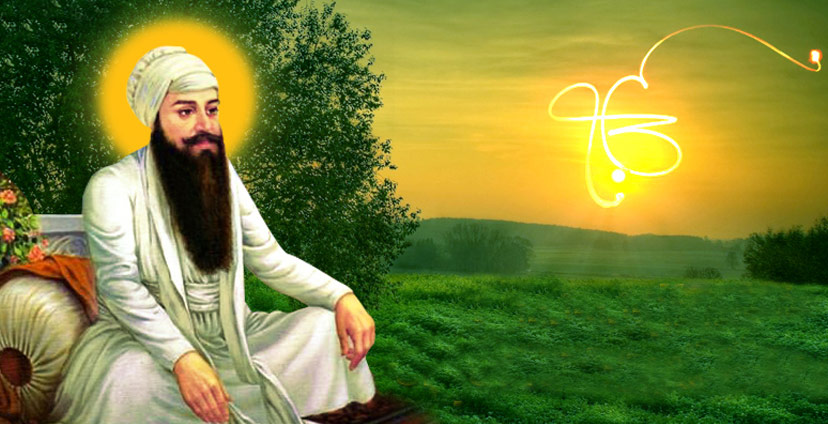

Sri Guru Angad Dev Ji, the second of the ten Sikh Gurus, was born on 31 March 1504 CE at Matte di Sarai (now Sarai Naga), Sri Muktsar Sahib, Punjab, India to Baba Pheru Mal Ji and Mata Daya Kaur Ji (also known as Sabhrai Ji). He was given the name Lahna and later married Mata Khivi Ji. The couple was blessed with two sons, Bhai Dasu Ji and Bhai Datu Ji, and two daughters, Bibi Amro Ji and Bibi Anokhi Ji.
Baba Pheru Mal Ji was an educated and well-respected munshi in the service of Chaudhary Takhat Mal of Matte di Sarai. Later, the family moved to Harike Pattan and eventually settled at Khadur Sahib, where Baba Pheru Mal Ji engaged in trade and established his household.
Before coming into the fold of Sri Guru Nanak Dev Ji, Bhai Lahna Ji and his family were devoted followers of Vaishno Devi, a revered Hindu deity, and he regularly led groups of pilgrims to her shrine. However, despite his sincere devotion, religious observances, and worldly comforts, he did not find the lasting inner peace he sought and continued his search for spiritual truth. At Khadur Sahib, he once heard Bhai Jodh Ji reciting the bani of Sri Guru Nanak Dev Ji:
ਜਿਤੁ ਸੇਵਿਐ ਸੁਖੁ ਪਾਈਐ ਸੋ ਸਾਹਿਬੁ ਸਦਾ ਸਮਾਲੀਐ॥
ਜਿਤੁ ਕੀਤਾ ਪਾਈਐ ਆਪਣਾ ਸਾ ਘਾਲ ਬੁਰੀ ਕਿਉ ਘਾਲੀਐ॥
[One should always remember the Master, by serving whom peace is obtained. Since one must reap the fruits of one's own actions, why should one engage in evil deeds?]
The message of the Guru's words deeply moved him and inspired an intense longing to meet Sri Guru Nanak Dev Ji. Bhai Lahna Ji soon travelled to Kartarpur Sahib to seek the blessings of Sri Guru Nanak Dev Ji. In the presence of the Guru, he experienced the inner peace for which he had been searching for many years. Embracing the Guru's path, he left behind his former religious practices, including ritualistic observances and the worship of deities, dedicating himself wholly to a life of truth, seva (selfless service), and remembrance of the Divine. Deeply inspired by Sri Guru Nanak Dev Ji's teachings, he chose to remain at Kartarpur Sahib and devoted himself wholeheartedly to the Guru's service. Under the spiritual guidance of Sri Guru Nanak Dev Ji, he developed and propagated the Gurmukhi script, which later became the foundation of the modern Punjabi language, one of the world’s most widely spoken languages.
From about 1532 to 1539 CE, Bhai Lahna Ji spent nearly seven years in the service of Sri Guru Nanak Dev Ji at Kartarpur Sahib. History records numerous accounts of his humility, obedience, selfless service, and spiritual discipline. During this period, he played a significant role in writing and preserving the sacred bani of Sri Guru Nanak Dev Ji and the Bhagats, which had been collected by Sri Guru Nanak Dev Ji during his long and extensive journeys across the Indian subcontinent and beyond. In doing so, he helped preserve the sacred bani that was later compiled by Sri Guru Arjan Dev Ji into Sri Guru Granth Sahib Ji. Through his deep devotion and complete surrender, he became so united with the Guru's mission that Sri Guru Nanak Dev Ji bestowed upon him the name “Angad,” meaning one who is a part of the Guru's own being.
On 6 September 1539 CE, Sri Guru Nanak Dev Ji entrusted the responsibility of Guruship to Bhai Lahna Ji, who became Sri Guru Angad Dev Ji. Sri Guru Nanak Dev Ji chose him as the second Guru because of his humility, devotion, discipline, and complete commitment to the path of truth, rather than appointing his own sons.
After receiving the Guruship, Sri Guru Angad Dev Ji carried forward the mission of Sri Guru Nanak Dev Ji from Khadur Sahib. He actively promoted the Sikh principles of Naam Japo (remember and meditate on the Divine Name), Kirat Karo (earn an honest living through hard work), and Vand Chhako (share one's earnings with others). He further strengthened the institutions of Sangat (holy congregation) and Pangat (the practice of sitting together as equals while partaking in Langar), while encouraging education, selfless service, humility, and honest living. He also contributed to Gurbani through 63 saloks of his own composition, which were later incorporated by Sri Guru Arjan Dev Ji into Sri Guru Granth Sahib Ji.
To promote learning and the holistic development of the community, Sri Guru Angad Dev Ji established a school at Khadur Sahib and encouraged physical fitness through the establishment of a wrestling arena (Mall Akhara). He personally devoted much of his time to teaching children, imparting spiritual wisdom, and nurturing intellectual, moral, and physical excellence among his students.
The importance Sri Guru Angad Dev Ji attached to education is evident from his encounter with the Mughal emperor Humayun. After suffering defeat at the hands of Sher Shah Suri in 1540 CE, Humayun came to seek the Guru's blessings and found him fully engaged in teaching young students at Khadur Sahib. So absorbed was the Guru in this noble task that He paid no attention to the emperor's arrival. Growing impatient at being kept waiting, Humayun placed his hand on the hilt of his sword. The Guru then reminded him that the courage he had failed to display on the battlefield should not be directed towards a humble spiritual teacher. Deeply humbled by the Guru's wisdom, Humayun sought forgiveness and received his blessings. This episode reflects the Guru's conviction that the pursuit of knowledge, character, and spiritual understanding was of greater importance than worldly rank, power, and status.
Mata Khivi Ji, wife of Sri Guru Angad Dev Ji, is remembered for her devotion, selfless service, and significant contribution to strengthening the institution of Langar. Their daughter, Bibi Amro Ji, also occupies an honoured place in history. One day, while Bibi Amro Ji was reciting Gurbani with deep devotion, Baba Amardaas Ji listened to the Guru's words and was profoundly moved by the divine wisdom contained in Gurbani. The Guru's message touched his heart, revealing the spiritual truth and inner peace for which he had been searching for many years. Although he had spent much of his life engaged in religious observances, including annual pilgrimages to Haridwar and ritual bathing in the River Ganga, he had not found such lasting fulfilment. Inspired by Gurbani, he sought the blessings of Sri Guru Angad Dev Ji and embraced the Guru's path. Through years of humble service, spiritual discipline, and unwavering devotion, he became one with the Guru's mission.
Before merging with the Eternal Light, Sri Guru Angad Dev Ji bestowed the Guruship upon Baba Amardaas Ji, who succeeded him as Sri Guru Amardaas Ji. Sri Guru Angad Dev Ji merged with the Eternal Light at Khadur Sahib on 29 March 1552 CE.
Sri Guru Angad Dev Ji is remembered for his humility, selfless service, discipline, development and propagation of Gurmukhi script, preservation of Gurbani, strengthening of the institutions of Langar, Sangat and Pangat, promotion of education and physical fitness, and for carrying forward the mission of Sri Guru Nanak Dev Ji with complete devotion. .